
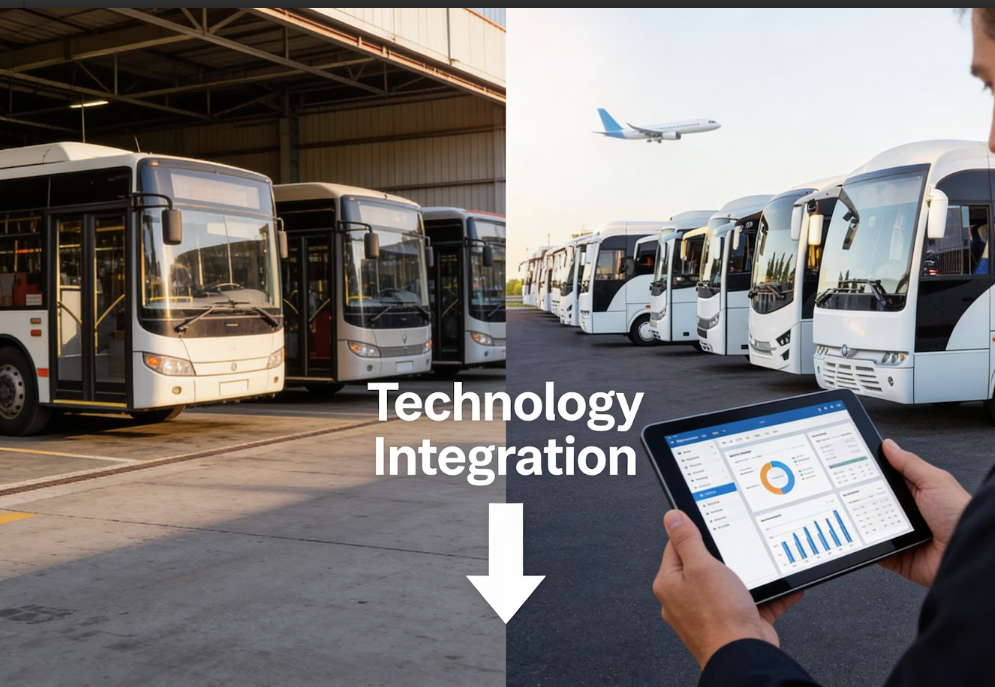
Five years ago, in 2021, fleet management was a different world. Not ancient history different, but different enough that going back would feel like using a flip phone after getting used to a smartphone. The tools existed. They just didn’t do much.
I think the easiest way to explain the shift is to walk through what a typical fleet operation looked like then, what it looks like now, and what actually caused the change. It wasn’t one product or one technology. It was a bunch of things maturing at the same time.
Fleet management in 2021
In 2021, most fleet managers had telematics. Technically. What that usually meant was a GPS tracker on each vehicle, a web dashboard showing dots on a map, and maybe some basic speed and idle alerts. The fancier setups included fuel consumption data and geofence notifications.
Maintenance was calendar-based. Oil changes every 15,000 miles. Brake inspections every quarter. Tire rotations on a schedule. Whether the vehicle needed it or not. If something failed between intervals, you dealt with it. The mechanic would plug in a scanner, read the fault codes, scratch their head for a while, and figure it out.
Driver behavior monitoring existed, but it was crude. Hard braking event. Speeding event. Rapid acceleration event. That was the extent of the insight. No context about whether the braking was on a hill or a straightaway. No comparison across drivers on the same route. Just a pile of event logs that someone was supposed to read.
Fuel tracking was mostly about theft prevention. Did the fuel level drop suspiciously overnight? That was about the limit of what most systems could tell you.
And the data lived in silos. GPS data in one platform. Fuel data somewhere else. Maintenance records in a spreadsheet or maybe a basic CMMS. Driver behavior alerts in an email inbox. Nothing talked to anything else.
Fleet management in 2026
The fleet manager’s job hasn’t changed. Keep the trucks moving, keep the drivers safe, keep costs down. But the tools are unrecognizable.
Maintenance isn’t calendar-based anymore, at least not for fleets that are paying attention. Intangles’ predictive health monitoring watches engine, battery, coolant, air intake, and exhaust systems continuously and flags component degradation before fault codes trigger. The mechanic doesn’t diagnose blind. They walk into the shop already knowing what’s wrong, with parts pre-ordered. Unplanned breakdowns have dropped 30-40% for fleets running this kind of system.
Driver behavior monitoring went from event counting to actual intelligence. Intangles’ driving behavior monitoring tracks over 20 behavior exceptions, adjusts for route difficulty and driving conditions, and generates driver scorecards instead of raw event logs. Fleet managers can compare drivers on the same route fairly and coach specific behaviors. The system also connects driving patterns to vehicle wear and fuel waste, so when a driver’s habits are eating through brake pads faster than average, the cost is visible.
Fuel monitoring stopped being just a theft alarm. Intangles’ fuel monitoring breaks down whether consumption changes come from routes, idling, driver behavior, or mechanical issues. Fleet managers know why fuel costs went up, not just that they did.
And the data silos collapsed. The best platforms now run everything on the same data layer. Vehicle health, driver behavior, fuel, location, maintenance scheduling. When one system can see that a fuel spike on Vehicle #22 is caused by a driver habit that’s also accelerating brake wear, you get one intervention that solves two problems. That was impossible when each data stream lived on a different platform.
What actually caused the shift
Three things happened between 2021 and 2026 that made all of this possible.
AI models got enough training data. Predictive maintenance needs millions of miles of vehicle behavior data to work accurately. In 2021, most platforms hadn’t been collecting long enough. By 2024-2025, the companies that started early, Intangles among them, had enough historical failure data across enough vehicle types and operating conditions to make their models reliable. Intangles now monitors over 175,000 assets across 17 countries. That volume of data is what makes the difference between a useful prediction and a false alarm.
Connectivity got cheaper and faster. Streaming high-frequency sensor data from a truck in rural Wyoming to a cloud server used to be expensive and unreliable. Better LTE coverage and falling data costs made continuous monitoring practical for fleets of all sizes, not just enterprise operations with deep pockets.
Fleet managers started demanding outcomes instead of dashboards. This one is underrated. In 2021, a lot of telematics purchases were checkbox decisions. “We need GPS tracking.” By 2024, fleet managers had seen enough demos and enough competitor results to start asking harder questions. “What will this actually change about how we operate?” That pressure pushed vendors to build platforms that delivered intelligence, not just data.
What hasn’t changed
The truck still breaks down sometimes. Drivers still speed. Fuel still costs too much. Fleet management is still a hard job with thin margins and constant pressure.
What changed is that the fleet manager isn’t guessing anymore. They’re not waiting for a phone call about a stranded truck. They’re not sending generic “drive safer” emails. They’re not staring at a dashboard full of numbers that don’t connect to each other.
They’re making decisions with real data, real context, and real predictions. And the fleets that made this shift two years ago are already seeing compound returns that late adopters will struggle to catch up to.
The technology didn’t change the job. It changed how well you can do it.
Frequently asked questions
How has fleet management changed in the last 5 years?
Fleet management has shifted from GPS tracking and calendar-based maintenance to AI-powered predictive operations. In 2021, most fleets ran on basic telematics with siloed data. By 2026, platforms like Intangles provide continuous vehicle health monitoring, AI-driven driver scorecards, integrated fuel analysis, and predictive maintenance that catches failures days before they happen. The biggest change is that data streams now connect across domains, so fleet managers get actionable intelligence instead of disconnected dashboards.
What is predictive maintenance and why does it matter for fleets?
Predictive maintenance uses continuous sensor data and AI analysis to detect component degradation before failure occurs. Instead of servicing every vehicle on a fixed schedule, fleet managers service vehicles when data indicates actual need. Intangles’ predictive health monitoring tracks engine, battery, coolant, and exhaust systems in real time, flagging issues before fault codes trigger. Fleets using this approach see 30-40% fewer unplanned breakdowns and lower parts costs from eliminating unnecessary scheduled replacements.
How has driver behavior monitoring improved since 2021?
In 2021, driver monitoring was mostly event counting: hard brakes, speeding incidents, rapid acceleration. No context, no comparison, no connection to costs. Today, Intangles’ driving behavior monitoring tracks 20+ behavior exceptions, adjusts for route difficulty, generates per-driver scorecards, and correlates driving patterns with vehicle wear and fuel consumption. Fleet managers can identify which specific habits are costing money and coach individual drivers with evidence.
Why did fleet telematics improve so rapidly between 2021 and 2026?
Three factors converged. AI models accumulated enough historical vehicle data to make accurate predictions (Intangles now monitors 175,000+ assets across 17 countries). Connectivity costs dropped, making continuous data streaming practical for mid-size fleets. And fleet managers started demanding measurable operational outcomes instead of just dashboards with dots on maps, which pushed vendors to build platforms that deliver intelligence rather than raw data.
Can mid-size fleets afford modern fleet management technology?
Yes. The cost of fleet intelligence platforms has dropped significantly since 2021. Connectivity is cheaper, and platforms like Intangles that work through standard OBD ports without requiring expensive custom hardware have made adoption practical for fleets with 30-100 vehicles. The per-vehicle ROI is actually more visible in mid-size fleets because each avoided breakdown has a proportionally larger operational impact.